
Checking Criminal History in Madison County
Begin with the record that answers the question. Iowa Courts Online is the best first stop for a filed Madison County charge and its disposition. The Madison County Clerk of Court supplies the underlying complaint, order, judgment, certified copy, older file, or public-terminal help. The sheriff holds sheriff-created incident reports and jail records. DCI supplies a statewide Iowa criminal-history response. Iowa DOC covers state prison and public supervision data, while the Iowa Sex Offender Registry is a separate safety resource.
Names can point to the wrong person. Gather the full name, exact date of birth, spelling variants, case or incident number, and event date when known.
- Search Iowa Courts Online by last name, Madison County, and the right criminal case type. Use a known case number when possible.
- Read each charge-level disposition, filing, bond entry, and financial field. A case marked disposed does not always mean a conviction.
- Ask the clerk for the actual document when docket metadata does not answer the question.
- Check current custody through the county roster and sheriff phone line, not through the court index alone.
- Order a DCI response when the goal is a broader Iowa history, then compare any mismatch with the source agency and court.
The official Madison County homepage shows the courthouse as the county’s central service point.
That county entry point helps separate court business from the sheriff and jail counter farther north on John Wayne Drive.
One Madison Event, Four Criminal Files
A single Madison County event can create four records that do not say the same thing. The arresting agency writes an incident or arrest report. The jail creates an intake and custody record. If the County Attorney files a charge, the Iowa Judicial Branch opens a District Court case. Fingerprint-supported arrest data and later disposition reports can enter DCI’s state repository. Each file has a different custodian, timing, and purpose.
This split explains many gaps. A booking may appear before a court case. The filed charge may differ from the officer’s first allegation. A dismissal may reach the court docket before DCI updates its response. Compare the arresting agency record, clerk’s file, and DCI result before deciding that one source is wrong.
| Channel | Best use | How to reach it |
|---|---|---|
| Iowa Courts Online and clerk | Filed charges, docket, disposition, sentence, copies | Online search, public terminal, phone, mail, or counter |
| Madison County Sheriff and jail | Sheriff reports, booking questions, present custody | Roster, linked request form, phone, fax, mail, or lobby |
| Iowa DCI | Iowa fingerprint-supported criminal history | Online, email, fax, mail, or in person |
| Iowa DOC and Fifth District | State custody and public supervision status | Offender Search, district contact, or records request |
The county office directory places the clerk, sheriff, and County Attorney in their proper roles.
Using that directory first can prevent a public-record request from going to an office that never created or kept the requested file.
Note: A name match is a lead, not proof that the record belongs to the person being researched.
Iowa Official Background Checks
The official state route for Madison County is the Iowa Department of Public Safety, Division of Criminal Investigation, Criminal History Record Dissemination Unit. DCI charges $15 per last name. First name, last name, and exact date of birth are required. Middle name, gender, and Social Security number can help distinguish similar names. A separate submission and payment are required for each last name.
Iowa permits a public requester to seek a name-based Iowa check without a general release. A signed release is needed for available information about a discharged deferred judgment. The response covers Iowa data only. It excludes other-state, FBI, and federal convictions. Iowa also limits release of arrest information more than 18 months old when DCI has no final disposition. Online processing is posted at one to three days. DCI accepts requests by email, fax, mail, and in person, but not by phone.
The Iowa background-check instructions outline the official request path.
The state instructions are the right place to confirm the live forms and submission choices before paying for a Madison County record check.
Madison DCI Criminal Record Fields
DCI requires both a request form and a billing form. The result is identity-oriented and fingerprint-supported, not a copy of every Madison County pleading. A “record found” response reports what Iowa law permits DCI to release. A “no Iowa criminal history found” result can also reflect confidential juvenile information or other data that cannot be released, so a Madison County requester should not treat it as a certificate that no justice-system contact ever occurred.
| Field | Required | Use or format |
|---|---|---|
| First and last name | Yes | One last name per $15 request |
| Exact date of birth | Yes | Main identity match with the name |
| Middle name and gender | No | Useful matching aids |
| Address, fax, or email | For chosen delivery | Must align on request and billing forms |
| Card or DCI account | For online billing | Visa, MasterCard, Discover, or DCI account |
| Release authorization | Conditional | Used for available discharged deferred-judgment information |
The DCI Criminal History Record Check Information page is the source for current forms, limits, and payment details.
Reviewing those DCI terms helps a Madison County searcher understand why a state response and a local docket can differ without either being a full substitute for the other.
Criminal Record Types
Madison County criminal records are divided by the action that creates them. The sheriff, Winterset Police, Earlham Police, Iowa State Patrol, clerk, DCI, DOC, and registry do not merge all material into one public file. A useful lookup identifies both the record type and its creator.
- Arrest and booking records: agency reports describe the event, while jail entries describe intake, bond, and custody.
- Criminal court cases: the Madison County Clerk keeps filed charges, docket events, orders, dispositions, sentences, and financial entries.
- DCI history: the state repository combines releasable Iowa arrest cycles, court outcomes, and custody information.
- Warrants: courts issue them and law enforcement executes them, but Madison County has no verified public active-warrant list.
- Custody and supervision: the county jail covers local custody, while Iowa DOC covers prison and public probation or parole data.
- Registry records: the sheriff handles local registration and sends qualifying updates to DCI’s statewide registry.
The Iowa Sex Offender Registry supports Basic, Advanced, Map, Telephone, and Email searches. Its account tools add change watches, while NSOPW supplies the cross-state layer. Registration questions go to the Madison County Sheriff. The registry is separate from an arrest log, court docket, or DCI name check.
For the shift from an allegation to the filed charge and outcome, use the dedicated Madison County criminal court cases resource.
Madison County Jail Record Limits
The Madison County Jail is a 12-bed facility at 1012 N. John Wayne Drive in Winterset. Its official roster showed no query fields, filters, result columns, or entries when research was completed. That blank display must not be read as proof that no one is held. Start with the roster, then call the sheriff at 515-462-3575, ask at the jail lobby, or make a focused chapter 22 request for a releasable booking record.
VINE at 1-888-742-8463 provides custody notifications. After a transfer or sentence to state custody, Iowa DOC Offender Search becomes the right locator. Federal custody belongs in the Federal Bureau of Prisons locator. The county roster remains the local pretrial and short-term source. The full sequence and agency contacts appear in the Madison County arrest lookup.
The county service information provides practical courthouse and county-office context.
County service details help plan a call or counter request when the online custody display does not provide a reliable answer.
Note: Current custody, a filed criminal case, and a final conviction are three different facts held in separate Madison County records.
Inside a Madison County Criminal Record
The contents depend on which Madison County criminal record is open. A District Court case can show its number, type, filing date, judge, charge, statute, hearings, disposition, sentence, and financial ledger. A booking entry is narrower, with intake, arresting agency, initial charge, bond, and custody status. A DCI response organizes releasable Iowa history around identity and fingerprint-supported arrest cycles.
| Name and Identifiers | Name and enough identifying information to match the subject; protected numbers may be suppressed. |
|---|---|
| Arrest and Booking | Arresting agency, intake timing, initial allegation, bond, and current custody or release status. |
| Charges and Statutes | Filed count, Iowa charge code, description, and offense class in the court record. |
| Disposition | Outcome for each charge, such as dismissal, acquittal, deferred judgment, plea, or trial conviction. |
| Sentence | Court-ordered consequence, financial obligations, and related docket entries when public. |
| Custody or Supervision | County custody in jail data, or public prison, probation, and parole categories through Iowa DOC. |
The County Attorney evaluates arrest-stage allegations and decides whether and what to prosecute under Iowa law. The Madison County Attorney page describes that charging role.
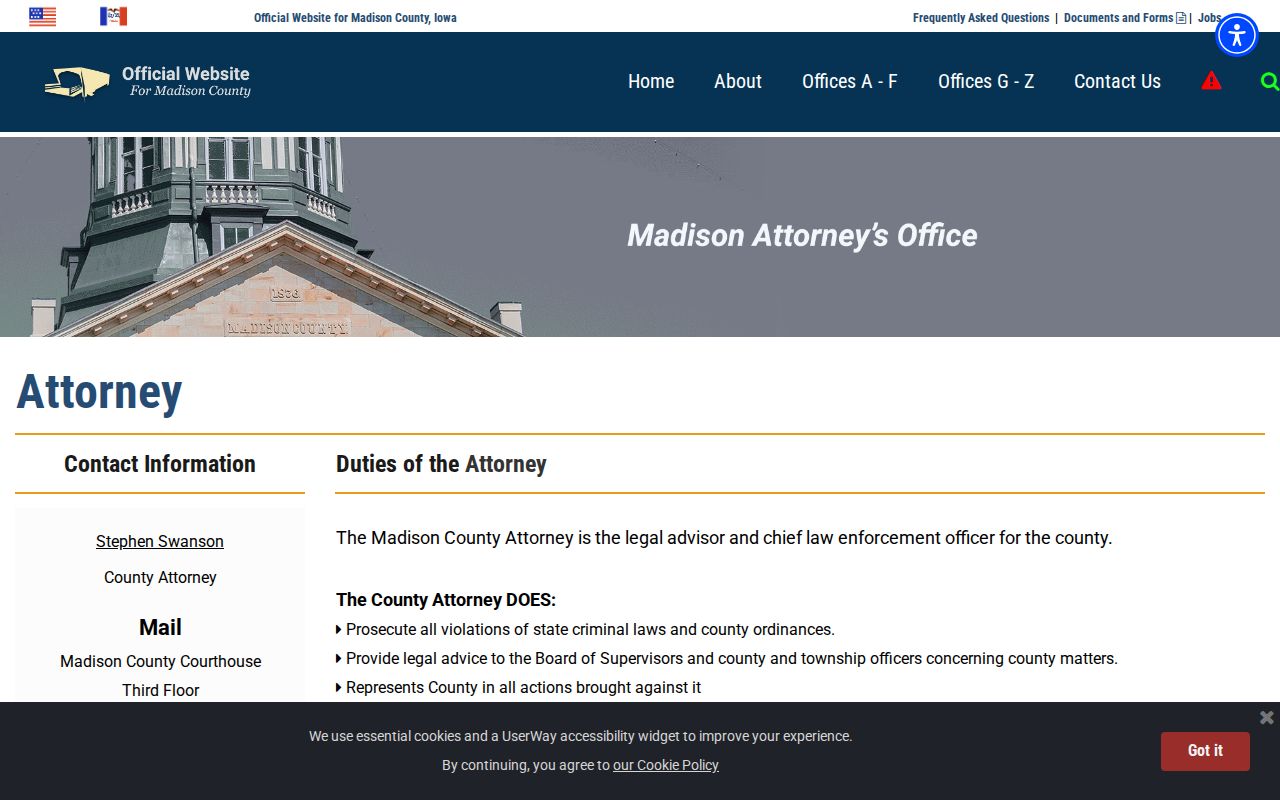
That prosecutorial step is why a booking label may not match the charge later filed in the Madison County court record.
Madison County Warrant Record Chain
No official public Madison County active-warrant database, most-wanted page, app, or statewide public e-warrant search was verified. Iowa court guidance also says a criminal case with an outstanding arrest or search warrant is confidential until service. A correct name search may therefore return nothing even when process exists.
Call the sheriff at 515-462-3575 without assuming staff can confirm the matter by phone. A focused chapter 22 inquiry can ask for releasable information. The Madison County Clerk at 515-462-4451 can address public court records, and Iowa Courts Online may show the case after it becomes public. If a warrant is verified, obtain the case number, issuing court, and public bail terms, then follow official or counsel instructions. Iowa’s June 2026 law change ended warrant-resolution clinics and requires scheduled bail, so older walk-in clinic advice should not be used.
Public Access Laws in Iowa
Iowa’s public-record framework starts with the Madison County custodian. Ask the sheriff for a sheriff report, the police department for its own report, the Madison County clerk for a court case, DCI for statewide criminal history, and DOC for public prison or supervision data. Chapter 22 supports inspection and copying, but it does not cancel separate confidentiality rules. Agencies may redact protected victims, minors, personal identifiers, and qualifying investigative content.
Key Iowa authorities:
Iowa Code chapter 22 grants access to public records and identifies confidential categories.
Iowa Code chapter 692 controls criminal-history dissemination, including older arrest data without a final disposition.
Iowa Court Rule 16.201 and related rules govern electronic court access and protected information.
Iowa Code sections 232.147 through 232.149 generally make juvenile court records confidential.
Iowa Code chapter 901C sets conditions for qualifying expungement.
A narrow request works best. Identify the creator, approximate date and time, location, case or report number, involved party or vehicle, and the exact item sought. Ask for electronic delivery, a fee estimate, expected timing, and the legal basis for any redaction.
Madison Criminal Records at County Offices
The Madison County Courthouse at 112 N. John Wayne Drive, Winterset, is the criminal-case counter. The clerk’s phone is 515-462-4451. Ask there for an official District Court file, certified copy, older material, or help with the public terminal. The courthouse is also where the County Attorney prosecutes state crimes and county ordinances. County offices generally post weekday hours from 8:00 a.m. to 4:30 p.m.
The sheriff and jail are at 1012 N. John Wayne Drive, PO Box 517, Winterset. Call 515-462-3575 or fax 515-462-3684 for the sheriff’s incident-copy procedure, a booking question, custody verification, or local registry contact. The office does not post a dedicated records email, public fee schedule, clearance-letter service, or promised turnaround. Confirm costs and ID needs before submission.
Madison County Clerk of Court
112 N. John Wayne Drive
PO Box 152
Winterset, IA 50273
515-462-4451
Madison County Sheriff and Jail
1012 N. John Wayne Drive
PO Box 517
Winterset, IA 50273
515-462-3575
Madison County Attorney
Courthouse, third floor
112 N. John Wayne Drive
Winterset, IA 50273
515-462-5034
Note: The Madison County Annex holds administrative offices, not the criminal-case clerk or the sheriff’s booking-record counter.
Sealed, Expunged, and Restricted Records
Madison County juvenile records are generally confidential under Iowa Code section 232.147. Outstanding arrest- or search-warrant cases can remain confidential until service. Madison County court and agency copies may also omit protected identifiers, victim or minor information, and qualifying investigative details. A missing online result may reflect one of these access rules rather than the absence of all records.
Iowa Code section 901C.2 addresses qualifying dismissals and not-guilty outcomes. Section 901C.3 creates a narrow, generally one-time path for certain misdemeanor convictions after more than eight years, when no charge is pending and all court debt is paid. Many offenses are excluded. Deferred judgments are treated separately under section 907.9. File through the Madison County Clerk using current Iowa Judicial Branch forms, and confirm the offense, outcome, dates, pending-case status, and balance before assuming eligibility.
After an order, check Iowa Courts Online and request a DCI self-result. If the DCI entry does not reflect the court’s action, use DCI’s dispute channel. Expungement makes a qualifying record confidential and can direct removal from DPS criminal-history files, but it should not be described as physical destruction of every government copy.
Madison Criminal Records in Fifth District
Madison County probation and parole are not run by a separate county probation office. Iowa DOC’s Fifth District serves the county and provides probation, parole, pretrial, electronic-monitoring, treatment, and fugitive services. The Iowa Board of Parole makes release decisions, while district officers supervise parolees in the community. The sentencing docket shows the court’s order; Iowa DOC controls supervision records.
Madison County public status can be checked through Iowa DOC Offender Search, the court sentencing record, Fifth District contact, or a focused DOC records request. Home street addresses and confidential casework are not part of the ordinary public view. DOC allows the first 30 minutes of search, assembly, and legal review without charge, then uses actual staff cost. Its published schedule includes paper copies at $0.15 per page and possible prepayment over $25.
The Fifth District page describes the supervision services that reach Madison County.
This district structure explains why a Madison County supervision question may leave the courthouse and move to a state office after sentencing.
The Iowa DOC open-records request page sets out the formal route for releasable custody and supervision records.
That request channel is useful when the public locator does not show the category of Madison County DOC information being sought.
Madison County Criminal Records by City
Madison County’s three largest incorporated cities follow different first steps. Winterset provides weekly activity reports and accepts focused chapter 22 requests by phone or at the police counter. Earlham publishes monthly reports and accepts city requests by email, mail, counter, or verbal inquiry, though writing is preferred. St. Charles contracts law enforcement to the Madison County Sheriff, so its city contact form is not a police-record portal. None has a separate municipal court, because local criminal cases flow through Iowa’s unified District Court and the Madison County Clerk.
Winterset Criminal Records
Population 5,520. Start with Winterset Police reports, then follow custody to the sheriff and filed cases to District Court.
Earlham Criminal Records
Population 1,396. Earlham Police and the City Clerk provide local report and records-request channels.
St. Charles Criminal Records
Population 641. Contract policing sends law-enforcement and booking questions to the Madison County Sheriff.
Madison Criminal Records Use One Court
Madison County has no Winterset, Earlham, or St. Charles municipal criminal court. Felonies and indictable misdemeanors are Iowa District Court cases. Magistrates handle simple misdemeanors, traffic matters, municipal infractions, and early criminal functions within the same unified system. A city citation therefore moves to the Madison County Clerk, not to a city court clerk.
For 2026, Madison County magistrate court is scheduled at the courthouse on Wednesdays from 9:00 a.m. to 4:30 p.m., except holidays or approved changes. That schedule can help a reader understand when preliminary court work occurs, but the clerk remains the records contact throughout the week. Use Iowa Courts Online for the public index and the courthouse counter or terminal for documents and deeper access.
- Disposition
- The result of a charge, such as dismissal, acquittal, deferred judgment, plea, or trial conviction.
- Deferred judgment
- An Iowa process that withholds judgment while conditions are completed; successful discharge may lead to dismissal and expungement.
- Trial information
- An Iowa prosecutor-filed charging document used for indictable offenses when law permits.
- Bench warrant
- A warrant often issued when a person does not meet a court requirement, such as appearing.
The Iowa Board of Parole is the state body that makes parole release decisions after the court and custody stages.
The board’s role comes later in the record chain and should not be confused with a Madison County court disposition or Fifth District supervision entry.